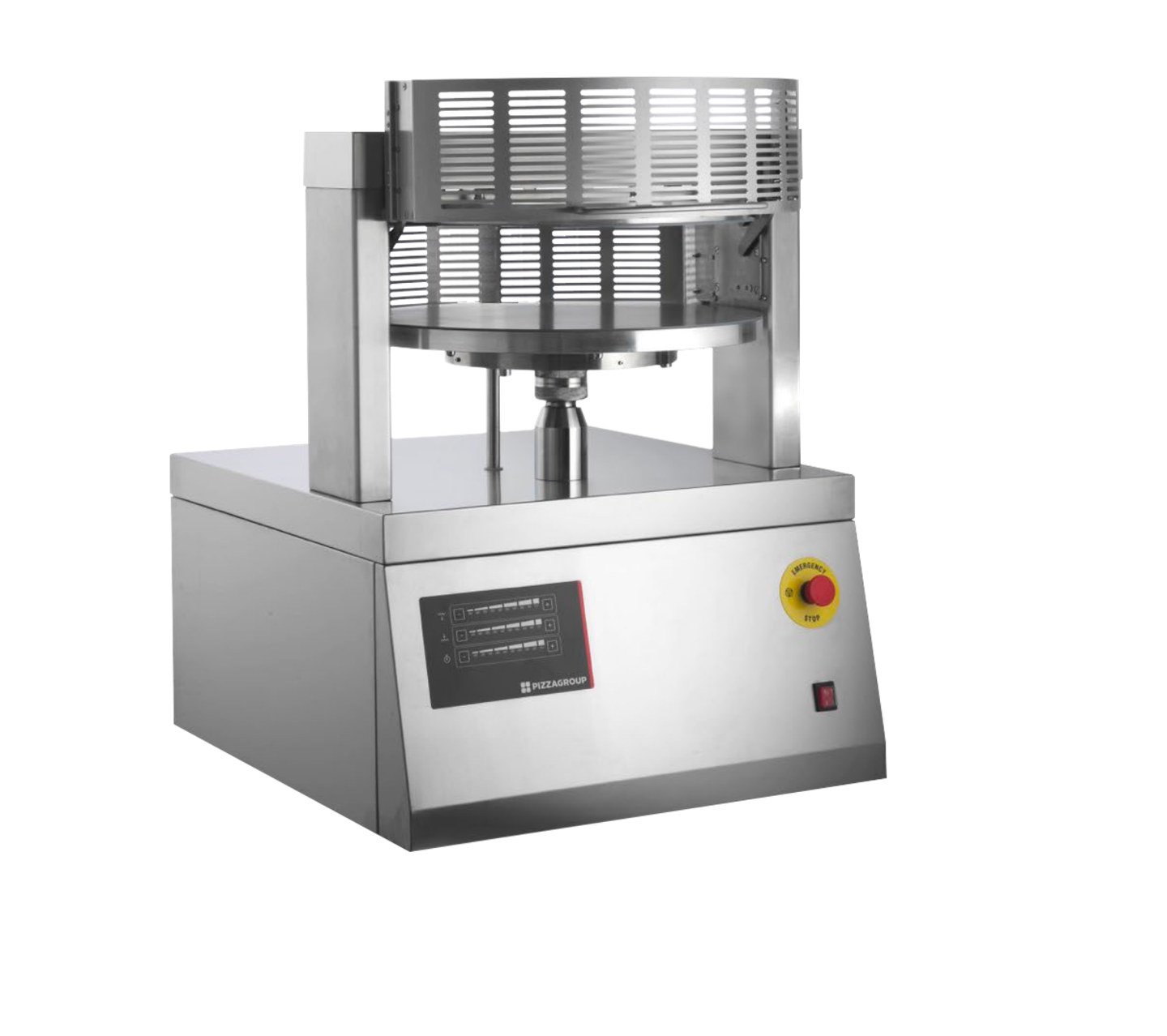
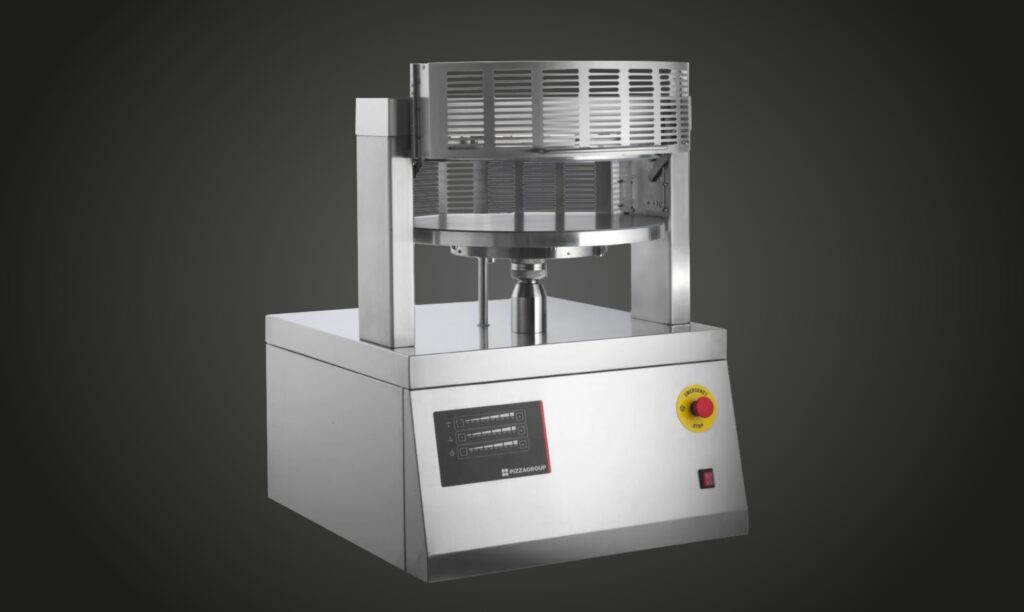
For high-volume pizzerias, franchise operations, and commercial kitchens that need to produce hundreds of perfectly uniform pizza bases every shift, the Dough Press delivers an unmatched combination of speed, consistency, and operational simplicity. Capable of pressing up to 240 pizza bases per hour in either 18-inch or 20-inch diameters, this machine transforms a labor-intensive, skill-dependent task into a streamlined, repeatable process that any trained operator can manage with confidence from day one.
Sineflon A Heated Plates: The Foundation of Quality
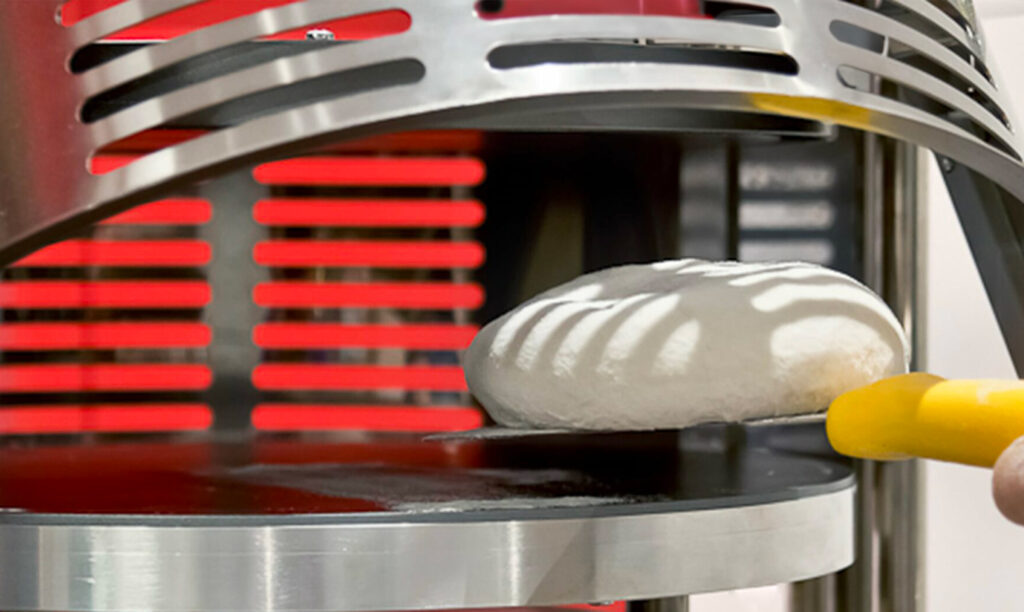
At the heart of the dough press are its Sineflon A heated plates — a food-safe certified non-stick surface material engineered specifically for direct contact with raw dough at elevated temperatures. Unlike conventional Teflon or generic non-stick coatings that degrade under sustained commercial heat cycling, Sineflon A maintains its release properties and surface integrity across thousands of pressing cycles. This means your dough balls release cleanly every single time without the need for flour dusting, oil spraying, or parchment paper — eliminating consumable costs and keeping your production line moving without interruptions for plate cleaning or surface reconditioning.
The plate heating system provides separate temperature control for the upper and lower plates, giving operators precise authority over how heat transfers into the dough during each pressing cycle. This dual-zone capability is far more than a convenience feature. Different dough formulations, hydration levels, and ambient kitchen temperatures all affect how dough responds to heat and pressure. A high-hydration Neapolitan-style dough at 65% water content behaves very differently under a heated press than a standard New York-style dough at 55% hydration. With independent upper and lower controls, you can fine-tune the thermal profile to match your specific recipe, ensuring the pressed base emerges with the exact texture, moisture distribution, and surface finish your customers expect.
Adjustable Pressing Time and Thickness: Total Control Over Every Base
The pressing time is adjustable from 0.1 seconds to 2.5 seconds, providing a remarkably wide operational window that accommodates everything from a quick pre-shape of a partially formed dough ball to a full press that produces a completely finished, ready-to-top pizza base. Shorter pressing times at higher temperatures produce a lightly set surface with a softer interior — ideal for operations that want a hand-stretched appearance with machine-level consistency. Longer pressing times with moderate heat create a fully formed, uniformly thin base that holds toppings securely without sagging or tearing during loading into the oven.
Thickness adjustment is handled through a 300-degree ring nut rotation system that provides smooth, stepless control over the gap between the upper and lower plates. This mechanical adjustment is deliberately analog — it does not rely on digital servos or electronic actuators that could drift, fail, or require calibration. Once you set your desired thickness, it stays exactly where you put it, shift after shift, until you physically choose to change it. This level of mechanical reliability is essential in a production environment where even a fraction of a millimeter of variation across a batch of 500 bases would be immediately noticeable in the finished pizza.
Three Saveable Profiles and Status Memory
The digital control system stores 3 independent usage profiles, each containing the complete set of operating parameters: upper plate temperature, lower plate temperature, pressing time, and related settings. This means a pizzeria that produces both an 18-inch thin-crust base and a 20-inch pan-style base can switch between their optimized configurations with a single button press rather than manually adjusting multiple settings each time. The profile system also enables different shift managers to maintain their preferred parameters without disrupting each other’s work.
When the machine is powered off — whether for overnight shutdown, cleaning, or an unexpected power interruption — the status memory function preserves all active settings. When you power the press back on, it returns to exactly the configuration it was using before shutdown. There is no re-entry of temperatures, no re-selection of profiles, no waiting for an operator to remember what settings were working yesterday. The machine picks up where it left off, which significantly reduces startup time at the beginning of each production day.
Built Without Hydraulics or Air Compressors
One of the most significant engineering decisions in the Dough Press is its entirely electromechanical drive system. There are no hydraulic cylinders, no pneumatic actuators, no air compressors, and no fluid reservoirs anywhere in the machine. This is not a cost-cutting measure — it is a deliberate design choice that eliminates an entire category of maintenance, contamination risk, and operational complexity from your kitchen.
Hydraulic systems in food production environments present a persistent risk of fluid leaks that can contaminate product, create slip hazards on kitchen floors, and require specialized technicians for repair. Pneumatic systems demand a dedicated compressor installation, regular drain maintenance, air line inspections, and generate continuous noise that contributes to kitchen fatigue over long shifts. The press avoids all of these issues entirely. The pressing force is generated through a robust electromechanical linkage that requires no fluids, produces no exhaust air, and operates with minimal noise. If your kitchen does not already have compressed air infrastructure, you do not need to install it. If it does, you free up that capacity for other equipment.
AISI 304 Stainless Steel Construction
The entire frame of the dough press is fabricated from AISI 304 stainless steel using 3mm tubular sheet construction. This is not decorative cladding over a mild steel skeleton — the structural members themselves are stainless, providing genuine corrosion resistance in the high-moisture, high-temperature environment of a commercial kitchen. The 3mm wall thickness delivers the rigidity necessary to maintain precise plate alignment under repeated pressing cycles without flexing, warping, or developing looseness in the frame joints over years of daily use.
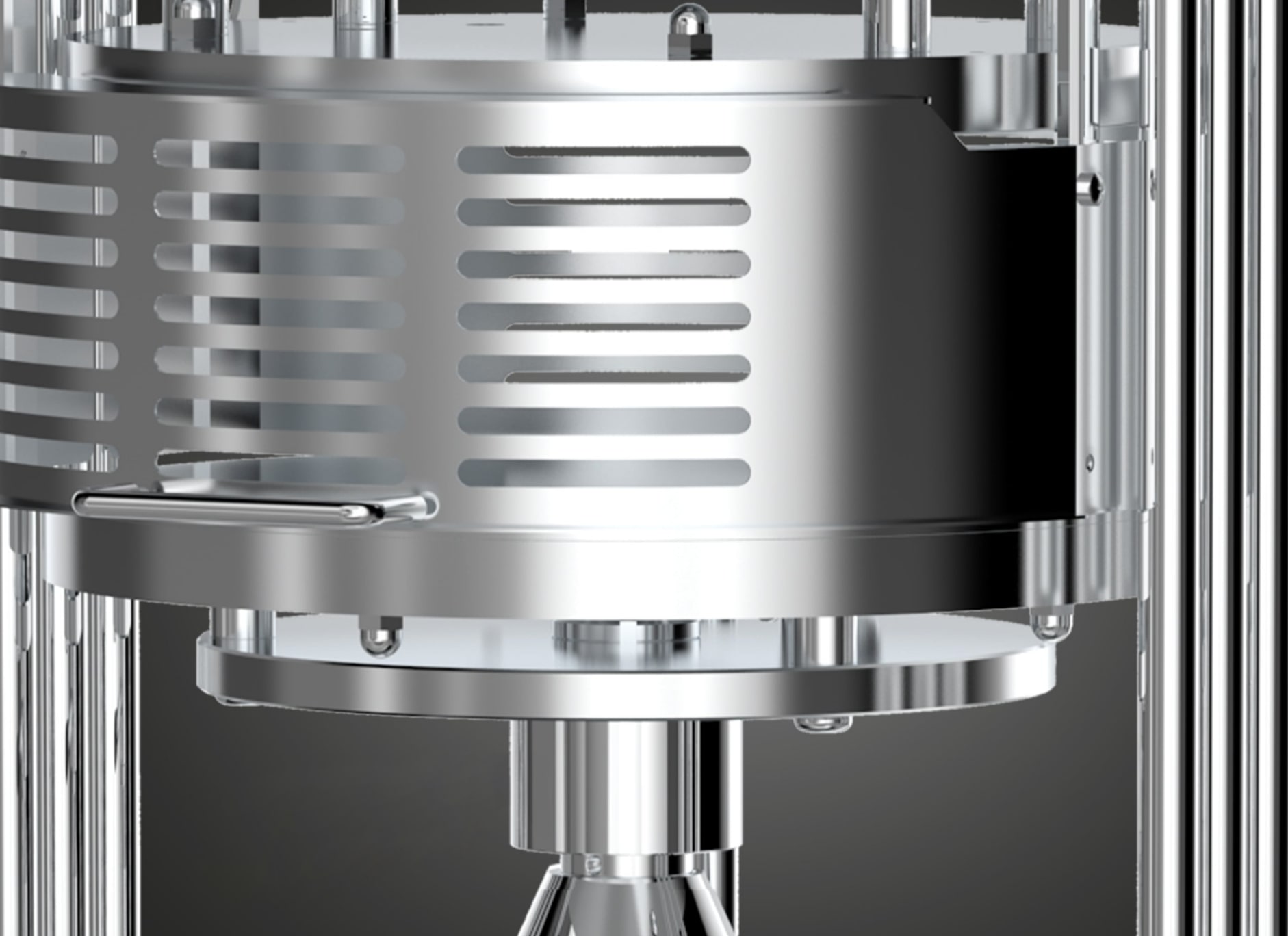
The safety guards are fully removable and dishwasher-safe, a practical detail that makes a meaningful difference in daily sanitation routines. Rather than wiping down fixed guards with sanitizer spray — inevitably missing crevices where dough residue accumulates — your cleaning crew can simply detach the guards, run them through the commercial dishwasher alongside your sheet pans and mixing bowls, and reinstall them in seconds. This approach delivers measurably better hygiene outcomes with less labor time than any fixed-guard design.
Custom Plates for Specialty Applications
Beyond the standard flat-press plates for traditional round pizza bases, custom plate configurations are available for specific applications. The most popular option is the Italian-style pizza edging plate, which forms a raised cornicione (rim) around the perimeter of the pressed base in a single operation. This eliminates the manual step of hand-forming the edge after pressing, further increasing throughput while delivering a consistent, professional-looking raised crust that holds sauces and toppings away from the plate edge during baking. Additional custom plate geometries are available on request for operators with unique base shape requirements.
Optional Stainless Steel Stand with Dough Trays
The optional stainless steel stand positions the press at ergonomic working height while providing integrated dough tray storage beneath the unit. This purpose-built stand keeps portioned dough balls within arm’s reach of the operator, eliminating unnecessary movement between a separate prep table and the press. In a high-speed production environment where every second counts, this integrated workflow design contributes directly to achieving the machine’s full 240 pizzas-per-hour throughput potential. The stand is constructed from the same AISI 304 stainless steel as the press itself, maintaining a unified, easy-to-clean appearance throughout your prep station.
Ideal Applications and Operations
The Dough Press is specifically engineered for operations where volume, consistency, and speed are non-negotiable requirements. High-volume pizzerias serving 300 or more covers per service benefit enormously from the machine’s ability to eliminate the bottleneck of manual dough stretching — a task that traditionally requires skilled labor and introduces significant variation between individual bases. Franchise operations and multi-unit chains gain particular advantage from the saveable profile system, which ensures that every location in the network produces identical bases regardless of operator experience level.
Commissary kitchens and central production facilities that prepare dough bases for distribution to satellite locations can leverage the full 240 pizzas-per-hour capacity during dedicated production runs, pre-pressing and par-baking bases that are then chilled or frozen for later use. This centralized production model dramatically reduces labor costs across the network while maintaining the uniformity that brand consistency demands. Hotels and resorts with multiple food and beverage outlets serving pizza — from poolside bars to room service to banquet operations — benefit from having a single machine that can supply all outlets from one prep kitchen, adapting quickly between different base sizes and thickness profiles as demand shifts throughout the day.
Catering companies and event operations that face unpredictable volume spikes find the dough press invaluable for its ability to ramp production quickly. When a last-minute order for 200 pizzas arrives for a corporate event, an operator can begin pressing bases immediately without the warm-up lag of hydraulic or pneumatic systems, producing the required quantity in under an hour while maintaining the quality standards your clients expect.
Maintenance and Longevity
The elimination of hydraulic and pneumatic systems means the maintenance profile of the Dough Press is remarkably simple. There are no hydraulic fluid changes, no compressor oil top-ups, no air line inspections, no pressure regulator adjustments, and no seal replacements to schedule. The electromechanical drive components are designed for tens of thousands of pressing cycles before requiring attention, and when service is eventually needed, it involves standard mechanical components rather than specialized hydraulic or pneumatic parts that may require extended lead times or specialized technicians.
Daily cleaning consists of wiping down the Sineflon A plates with a damp cloth after the final production run, removing and dishwashing the safety guards, and wiping the stainless steel exterior surfaces. The entire end-of-day cleaning procedure takes approximately ten minutes — a fraction of the time required for machines with complex mechanisms, hard-to-reach crevices, or non-removable guard assemblies. This cleaning simplicity not only saves labor time but also contributes to better hygiene outcomes, as there are fewer opportunities for dough residue to accumulate in areas that are difficult to inspect and sanitize.