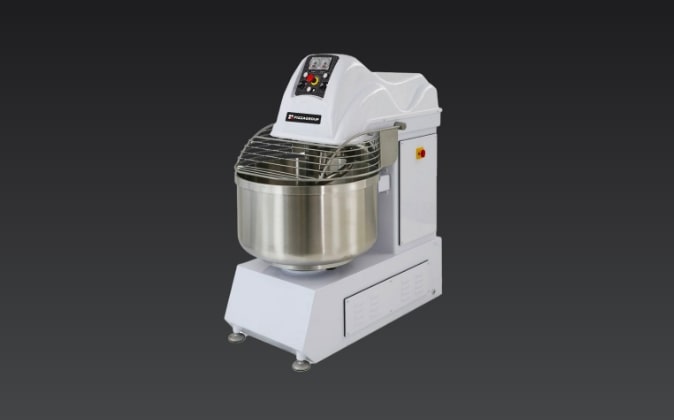
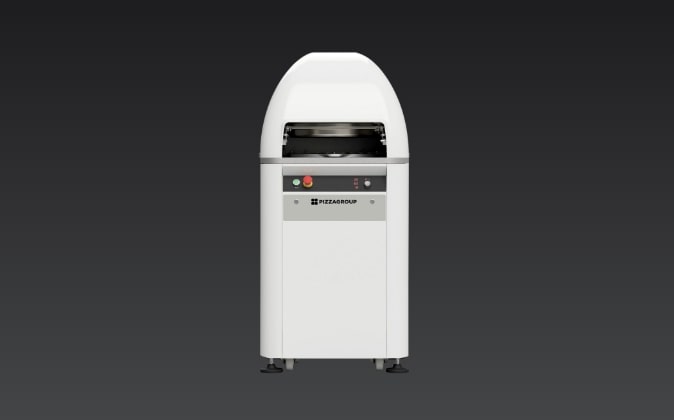
When your operation depends on consistently perfect dough — whether that means a 65% hydration Neapolitan-style ball or a stiff, low-moisture bagel dough that would stall a lesser machine — this Spiral Mixer delivers the mechanical authority your recipes demand. Purpose-built for the US market and available through Gianluca Specialty Imports, this line of automatic spiral mixers combines Italian engineering heritage with the rugged specifications American bakeries and pizzerias require for day-in, day-out production.
Dual Motor Architecture with Extra Pulley Drive
At the heart of every spiral mixer in this line sits a dual motor system that separates spiral rotation from bowl rotation into two independently powered functions. This is not a convenience feature — it is a fundamental engineering decision that directly impacts dough quality. By decoupling the spiral and bowl drives, each motor operates at its optimal load without the compromises inherent in single-motor designs that split torque through gearboxes. The spiral motor handles the demanding work of cutting through and developing gluten strands, while the bowl motor maintains smooth, consistent rotation regardless of how heavy or resistant the dough becomes.
The addition of an extra pulley drive on the spiral motor amplifies this advantage further. The pulley system multiplies the available torque at the spiral hook, giving the mixer the mechanical leverage to process high-gluten bread flours and stiff, low-hydration doughs that challenge conventional spiral mixers. Whether you are mixing a 50% hydration bagel dough, a dense pretzel mix, or a full batch of high-protein pizza dough at scale, the pulley-driven spiral maintains its rotation speed and cutting force without straining or overheating the motor.
Oversized Spiral for Thorough, Even Development
The spiral hook itself is engineered to be deliberately oversized relative to the bowl diameter. This is a critical detail that separates professional-grade equipment from machines that merely look the part. A larger spiral sweeps through a greater volume of dough on each rotation, ensuring that flour pockets are incorporated faster, hydration distributes more evenly, and gluten development proceeds uniformly throughout the entire batch rather than concentrating in the center while the edges remain undermixed. The result is dough that feels the same whether you pull a sample from the top, bottom, or sides of the bowl — the kind of batch consistency that translates directly into uniform bake results and predictable portion weights across hundreds of dough balls.
Reversing Bowl Rotation
The reversing bowl rotation feature sets these mixers apart from standard fixed-direction models. During mixing, the bowl can reverse its rotational direction, which fundamentally changes how dough interacts with the spiral hook. In a standard spiral mixer, dough naturally wraps around the hook and can form a mass that rides along with the spiral rather than being actively worked by it. Reversing the bowl breaks this pattern, forcing the dough to continuously re-engage with the spiral from changing angles. This produces more thorough gluten development in less time, lower final dough temperatures due to reduced friction from unnecessary over-mixing, and a more open crumb structure in the finished bake because the gluten network forms evenly rather than being torn and reformed repeatedly.
All Stainless Steel Where It Matters
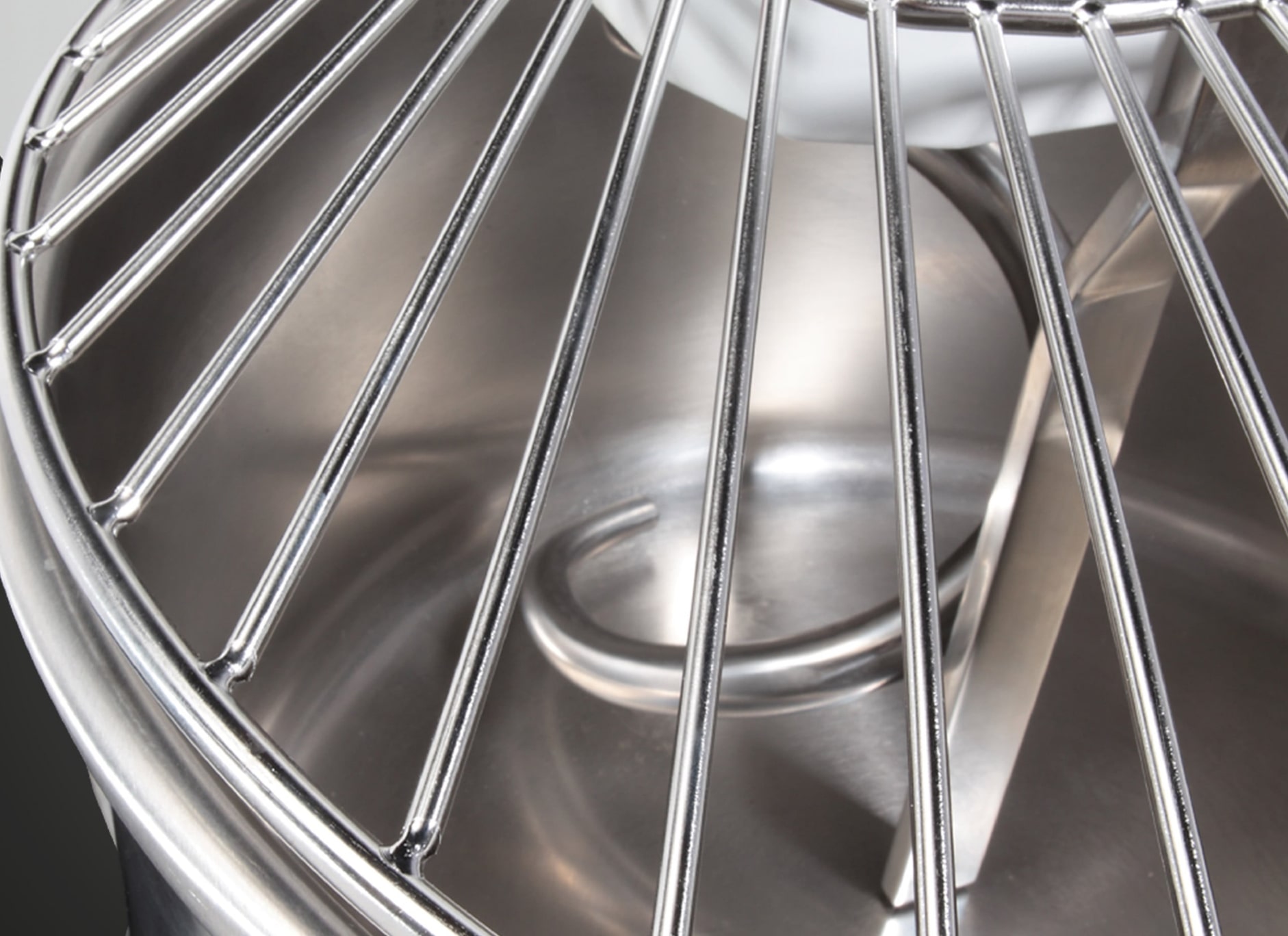
Every surface that contacts your dough — the bowl, lid, spiral hook, and dough breaker — is manufactured from stainless steel. This is not simply about durability, although stainless steel components will outlast painted or coated alternatives by years in a commercial environment. The real benefit is hygiene. Stainless steel does not harbor bacteria in microscopic surface cracks the way coated metals do over time, and it withstands the aggressive cleaning chemicals and high-pressure wash-down procedures that health codes demand in commercial food production. The stainless steel lid seals the bowl during operation, containing flour dust and preventing contamination while allowing you to monitor mixing progress through the integrated viewing window.
Precision Speed and Timer Controls
Every model in the range offers a choice of 1-speed, 2-speed, or variable speed spiral control, letting you match the mixer configuration to your production style. Two-speed operation is the most popular choice for pizzerias and bakeries that need a slow first speed for ingredient incorporation followed by a faster second speed for gluten development. Variable speed models give artisan bakers even finer control, allowing them to dial in the exact spiral velocity for specialty doughs like ciabatta or high-hydration focaccia where a precise window of mixing intensity produces the best crumb structure.
Two independent electronic timers manage each mixing phase automatically. Program your first-speed time for initial incorporation and your second-speed time for final development, and the mixer handles the transition and shutdown without operator intervention. This frees your team to manage other prep tasks during mixing and guarantees batch-to-batch consistency regardless of which employee is operating the equipment. The electronic controls are straightforward and intuitive — no complex programming menus or digital displays that fail in flour-heavy environments.
Compact Footprint, Mobile When You Need It
Despite their substantial dough capacities, the PM series mixers maintain a remarkably compact design that fits into production areas where floor space is at a premium. The PM60 occupies just 42.1 by 25.1 inches of floor space while handling 132 pounds of dough per batch, making it suitable for pizzerias, small bakeries, and commissary kitchens that need serious mixing capacity without dedicating half the room to equipment. All models are available on wheels, transforming a fixed installation into a mobile unit that can be repositioned for cleaning, shared between production areas, or rolled out of the way during off-hours to reclaim floor space for other tasks.
Designed Specifically for American Operations
Unlike many imported mixers that are simply rebadged European models with a voltage adapter, this spiral mixer line is designed with US market requirements in mind from the outset. Electrical specifications, safety certifications, dimensional standards, and performance characteristics are all calibrated for the American commercial kitchen environment. Gianluca Specialty Imports handles the complete import process — from factory order through ocean freight, customs clearance, and final delivery to your door — so you receive a machine that is ready to integrate into your operation without surprises or compatibility issues.
Built for Bakeries, Pizzerias, and Beyond
The PM60 is the ideal choice for single-location pizzerias producing 200 to 400 pies per day, artisan bakeries running moderate batch sizes, and commissary kitchens that need a reliable workhorse without the footprint of industrial equipment. The PM80 steps up to serve high-volume pizzerias, multi-unit commissary operations, and wholesale bakeries that run continuous production shifts. The PM130 is built for the largest operations — central production facilities, industrial bakeries, and high-output commissaries where every batch needs to maximize throughput. With 287 pounds of dough capacity per load in a 216-liter bowl, the PM130 can mix enough dough for over 1,000 standard pizza balls in a single batch.