Established 2013 • Serving South Florida & beyond • Certified service: (561) 695-9808
Italgi · Manufactured in Carasco since 1982 · Authorized US distributor

The machines behind America’s best fresh pasta programs

From compact countertop extruders to complete cooking workstations — every Italgi machine is built to run for decades and look beautiful doing it.

40+ YearsItalian Engineering Excellence
10–90 kg/hProduction Capacity Range
AISI 304Stainless Steel Construction

CE Certified • NSF Compatible • AISI 304/316 Stainless — Full US Support & Warranty

CE certified · AISI 304/316 stainless
Manufactured in Italy since 1982
Certified US service and parts
Serving operators in all 50 states

What forty years of focus look like

One family, one factory, one discipline. Italgi has spent four decades perfecting every machine in this range.

Fresh Pasta In-House

Produce spaghetti, fusilli, penne, ravioli, and dozens more shapes on demand. Eliminate supplier markups and deliver the freshest pasta possible — customers taste the difference immediately.

Automatic Precision

Programmable auto-lift pasta cookers cook every portion perfectly, every time. Set the time per basket, walk away, and let the machine deliver consistent results — no overcooking, no waste.

Built to Last

AISI 304 stainless steel bodies with AISI 316 marine-grade tanks that resist salt corrosion. Groove-free hygienic design for easy cleaning. Italian craftsmanship built to run for decades.

Show-Cooking Ready

Every machine is designed to look stunning in front of customers. Sleek Italian design turns your pasta station into theater — boosting perceived value and customer engagement.

Proven ROI

In-house pasta production costs a fraction of buying fresh. With production rates from 10 to 90 kg/h, these machines pay for themselves within months through reduced food costs alone.

Complete Solutions

From compact extruders to full cooking workstations with automatic cookers, bain-marie, induction plates, and refrigeration — Italgi covers every step from dough to plate.

The equipment we stand behind

Every machine is manufactured in Carasco, Italy, and backed by our authorized US service network.

Italgi CP900 automatic pasta cooker with 4 baskets and auto-lift system Automatic Cooker

CP900 Automatic Pasta Cooker

4-basket auto-lift system · 90 kg/h capacity

Ships in 4–6 weeks Made to order
  • Baskets: 4 independently timed
  • Power: 8.7 kW · 208V 3-phase
  • Tank: AISI 316 marine-grade steel
Italgi P17 commercial pasta extruder with stainless steel trolley Extruder

P17 Pasta Extruder

17 kg/h production · The restaurant standard

Ships in 4–6 weeks Made to order
  • Output: 17 kg/h actual production
  • Power: 1.1 kW · Single or 3-phase
  • Dies: 94mm interchangeable
Italgi P35A high-capacity pasta extruder with water-cooled system High Capacity

P35A Pasta Extruder

30 kg/h production · Water-cooled extrusion

Ships in 4–6 weeks Made to order
  • Output: 30 kg/h actual · 50 kg/h extrusion
  • Power: 2.1 kW · Single or 3-phase
  • Dies: 109mm · Water-cooled pipe
Italgi Estro compact countertop pasta extruder for restaurants Countertop

Estro Pasta Extruder

Compact 10 kg/h · Ideal for countertop service

In stock Ships in 3–5 days
  • Output: 10 kg/h actual · 18 kg/h extrusion
  • Power: 0.75 kW · Single phase
  • Size: 47×80×45 cm countertop
Italgi Pasta Idea Nabucco complete cooking workstation with auto-cooker and induction plates Workstation

Pasta Idea cooking workstations

Complete cooking stations · 4 to 9+ configurations

Made to order 8–12 week lead time
  • Models: Nabucco, Aida, Tosca, Turandot
  • Features: Auto-cooker + induction + bain-marie
  • Power: 10.4–15 kW · 400V 3-phase
ATA K7GCPP05 gas pasta cooker single tank 26 liters Gas Cooker

K7GCPP05 Gas Pasta Cooker

Single tank 26 Lt · Compact 700 Series

Ships in 4–6 weeks Made to order
  • Tank: 26 Lt · AISI 316 steel
  • Power: 8.70 kW · Gas (NG / LPG)
  • Size: 400 × 700 × 850 mm
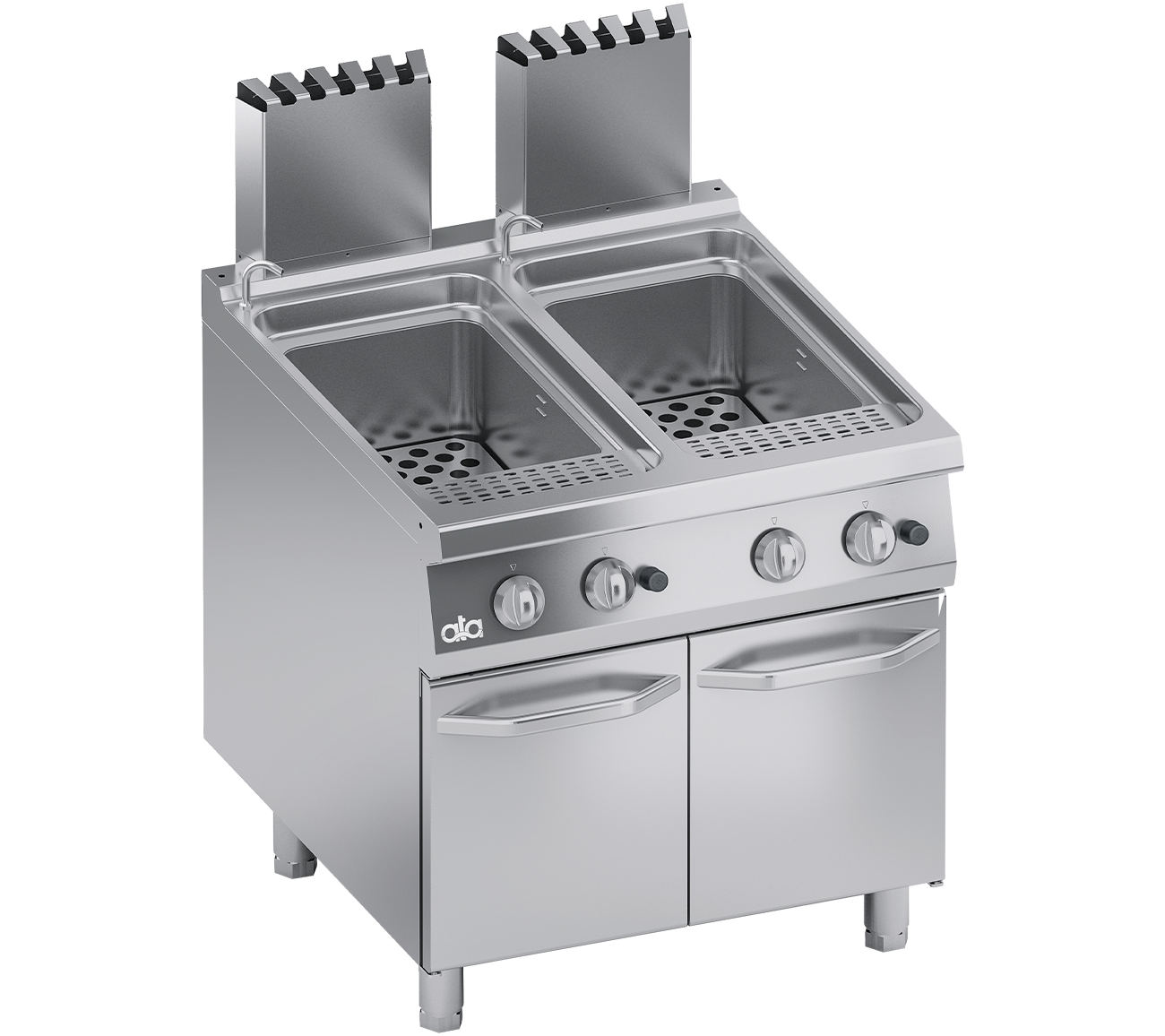
ATA K7GCPP10 gas pasta cooker double tank 26+26 liters Gas Cooker

K7GCPP10 Gas Pasta Cooker

Double tank 26+26 Lt · 700 Series

Ships in 4–6 weeks Made to order
  • Tanks: 26 + 26 Lt · AISI 316 steel
  • Power: 17.40 kW · Gas (NG / LPG)
  • Size: 800 × 700 × 850 mm
ATA K4GCPP05 gas pasta cooker single tank 40 liters Gas Cooker

K4GCPP05 Gas Pasta Cooker

Single tank 40 Lt · Full-size 900 Series

Ships in 4–6 weeks Made to order
  • Tank: 40 Lt · AISI 316 steel
  • Power: 14.00 kW · Gas (NG / LPG)
  • Size: 400 × 900 × 850 mm
ATA K4GCPP10 gas pasta cooker double tank 40+40 liters Gas Cooker

K4GCPP10 Gas Pasta Cooker

Double tank 40+40 Lt · 900 Series

Ships in 4–6 weeks Made to order
  • Tanks: 40 + 40 Lt · AISI 316 steel
  • Power: 28.00 kW · Gas (NG / LPG)
  • Size: 800 × 900 × 850 mm
Various fresh pasta shapes — spaghetti and tagliatelle — produced with interchangeable Italgi dies

Dozens of Pasta Shapes from One Machine

Every Italgi extruder uses interchangeable dies that swap in seconds, letting you produce spaghetti, fusilli, penne, maccheroni, bucatini, tagliatelle, lasagne sheets, and dozens more — all from the same machine.

  • Quick-change dies — switch shapes in under a minute
  • Compatible with ravioli attachment for filled pasta
  • Food-grade metal alloy dies built for thousands of cycles
  • Full dies catalogue available on request
Ask about dies options
Italgi Pasta Idea workstation diagram showing automatic cooker, bain-marie, induction plates, and refrigeration zones

Complete Cooking Workstations

The Pasta Idea line brings everything together: automatic pasta cookers, bain-marie for sauces, induction cooking plates, and refrigerated storage — in one stunning show-cooking station.

  • Automatic timed basket lifts — perfect pasta every time
  • Induction plates for sautéing and finishing sauces
  • Bain-marie keeps 5 sauces at serving temperature
  • Optional self-condensing hood with 3-zone filtration
Explore Workstations

Understanding commercial pasta equipment

What operators need to know before investing in fresh pasta production.

What a commercial pasta extruder actually does

A pasta extruder is a machine that mixes flour and water (or eggs) into dough, then forces that dough through a shaped opening called a die. The die determines the pasta shape — spaghetti, penne, fusilli, rigatoni, and dozens of others all come from the same machine with different dies installed.

The key difference between a commercial extruder and a domestic one is throughput and consistency. A commercial unit like the Italgi P17 produces 17 kg of finished pasta per hour, every hour, with uniform texture and diameter. The P35A pushes that to 30 kg/h with a water-cooled extrusion head that prevents the dough from overheating during continuous production — critical for maintaining the starch structure that gives fresh pasta its bite.

The compact Estro, at 10 kg/h, is designed specifically for countertop use. It sits on a prep table or in a front-of-house display where guests can watch pasta being made. This is not a compromise machine — it uses the same die system and produces the same quality. It simply serves a different operational model: visible craft rather than high-volume back-of-house production.

Extrusion vs. sheeting: choosing the right method

Extrusion pushes dough through a die under pressure. This is how you make short-cut pasta (penne, fusilli, rigatoni, maccheroni) and most long-cut shapes (spaghetti, bucatini, linguine). The dough is mixed and extruded in a single operation.

Sheeting rolls dough into thin, uniform sheets that are then cut into shapes like tagliatelle, pappardelle, fettuccine, or lasagne. The Italgi ravioli attachment works with sheeted dough to produce filled pasta at commercial speed.

Most serious pasta programs use both methods. Extruded pasta covers your staple menu shapes. Sheeted and filled pasta — ravioli, tortellini, agnolotti — becomes your high-margin signature offering. A single Italgi machine with the right attachments handles both workflows without requiring separate equipment.

Die materials and their effect on texture

The die material matters more than most operators realize. Bronze dies create a rough, porous surface on the pasta that holds sauce. This is the texture you associate with artisan Italian pasta — the sauce clings to every strand and fills every ridge. Teflon-coated dies produce a smoother, glossier surface that some operators prefer for specific dishes.

Italgi machines accept both bronze and Teflon dies in the same format. You do not need to choose one or the other at purchase time. Most operators start with a set of bronze dies for their core menu shapes and add specialty dies as their program evolves. A full dies catalogue is available on request, covering over 150 shapes from traditional Italian formats to custom profiles.

Automatic pasta cookers and the consistency problem

The hardest part of a high-volume pasta service is not making the pasta — it is cooking it consistently. During a busy dinner rush, a cook managing six portions simultaneously will inevitably overcook one or undercook another. The variance is small, but it accumulates across a full service and affects perceived quality.

An automatic pasta cooker like the Italgi CP900 solves this by giving each basket its own programmable timer. When the time is up, the basket lifts automatically — the cook does not need to watch the clock or make judgment calls. Four baskets operating independently means four different pasta shapes or portion sizes cooking simultaneously, each finished at exactly the right moment.

The tank is built from AISI 316 marine-grade stainless steel, the same alloy used in saltwater marine equipment. This matters because pasta cooking water contains dissolved starch and salt that corrode lesser steel grades over time. A 316 tank will last decades without pitting or discoloration, even under heavy daily use.

Choosing the right production capacity

Production capacity in pasta equipment is typically stated in two ways: extrusion rate and actual finished output. The extrusion rate is how fast the machine pushes dough through the die. The actual output accounts for the time needed to load ingredients, change dies, clean between batches, and handle the finished product. Actual output is always lower than the extrusion rate, and it is the number you should use for planning.

For a restaurant serving 80–120 covers per night with pasta on 40% of tickets, 10–17 kg/h of actual output is typically sufficient. You would run the extruder for 30–60 minutes during prep and have enough fresh pasta for the entire service. For a dedicated pasta bar, fresh pasta producer, or high-volume Italian restaurant, the P35A at 30 kg/h gives you headroom to grow without equipment constraints.

The Pasta Idea workstations are designed for operations where the entire pasta workflow — from raw dough to plated dish — happens in one station. These combine an automatic cooker, bain-marie for sauces, induction plates for finishing, and optional refrigeration. The Nabucco, Aida, Tosca, and Turandot configurations scale from compact two-station setups to full nine-element production lines.

Tell us what you are building

Describe your operation and we will recommend the right Italgi configuration — machine, dies, workstation layout, and power requirements — matched to the way you actually cook.

  • Custom quote within 24 hours
  • Authorized distributor with full manufacturer warranty
  • Full import handling & delivery to your door
  • Installation coordination & ongoing US support
  • Equipment training & recipe consultation

Start the Conversation

No obligation — we’ll respond within 24 hours

    Your information is secure and will never be shared. We’ll contact you within 24 hours.